4. Neural Network library
4.1. Overview
The basic building block is an Op, which is parameterized by the underyling storage type (see the Tensor documentation for more details). Every Op as the function apply, which performs a transform on the Op s input updating the output variable. Op s may have a variable number of inputs and outputs.
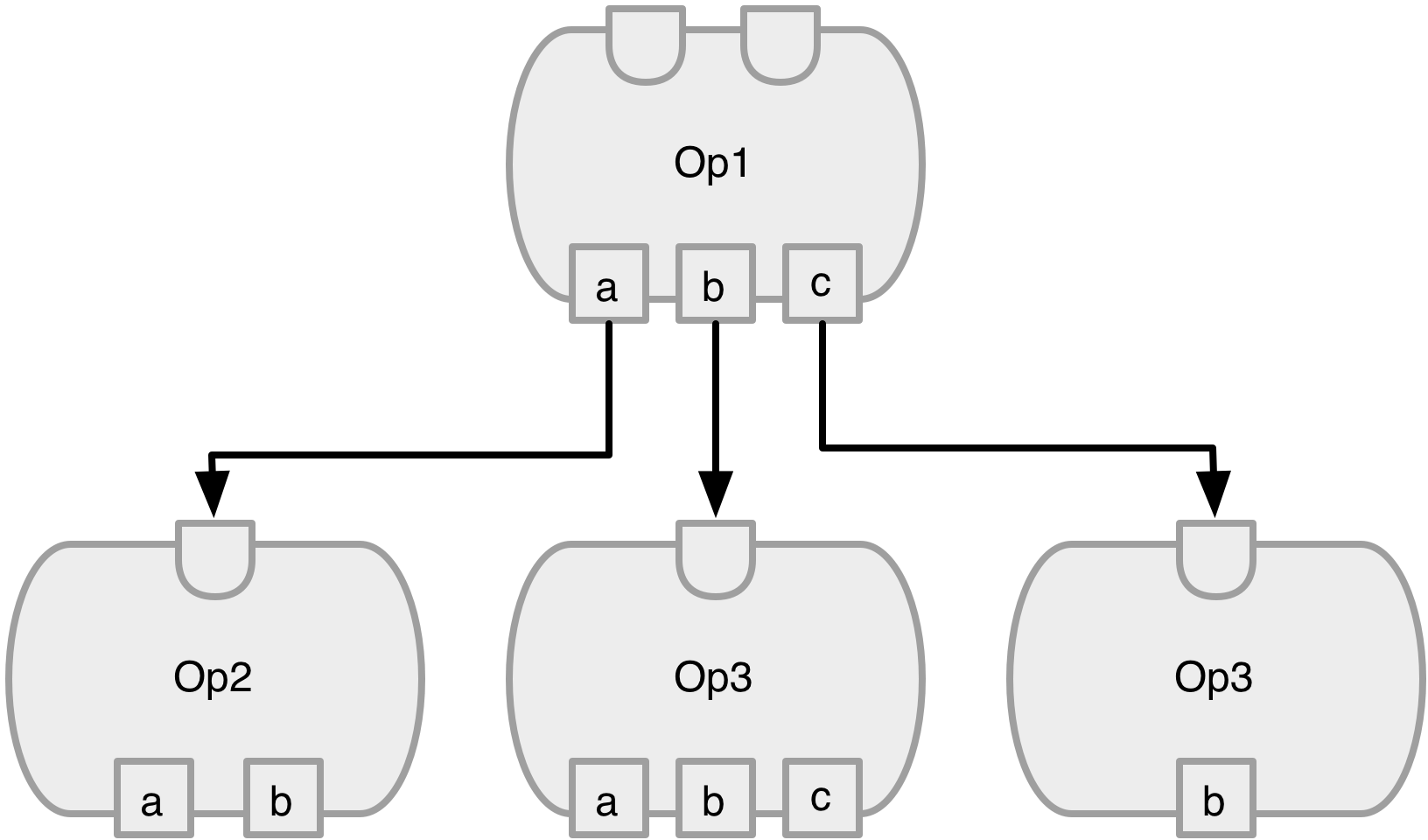
Figure 1: A computation graph is formed by connecting multiple Op s together. The inputs are a collection of Op s, and the outputs, the result of the operation applied to the input, are a collection of Tensor s.
The design of the Op class is keep the details of how the optimization is performed separate from the transform itself. For example, the protocol Differentiable provides a method to extend the Op class with the gradient method for stochastic gradient descent optimization. The gradient methods returns a new Op whose transform is the derivative of the target Op. This allows a secondary computation graph to easily be constructed:
let linear = Linear<D>(inputSize: 5, outputSize: 3)
let linearGrad = linear.gradient()
Some Op s, like Sequence are collections of other Op s, and will invoke (via apply) each of the contained Op s in a pre-determined order. For example, a standard neural network can be created with:
let net = Sequence<D>(
  VariableOp<D>(zeros(Extent(5))),
  Linear<D>(inputSize: 5, outputSize: 3),
  Sigmoid<D>(size: 3),
  L2Loss<D>(size: 3))

net.apply()
There are a few important items of note in this example:
- The
applymethod takes no parameters and has no return value - The input to the first layer of the network is of the type
Variable, which is also anOp - The loss function
L2Lossis also anOp
The design decision to make everything an Op allows the creation of the computational graph. In this case, all of the Op s are also Differentiable, and thus you can do:
let netGrad = net.gradient()
Optimization can be performed with the following code:
params = net.params()
gradParams = netGrad.params()

for i in 0..<iterations {
  netGrad.reset()

  net.apply()
  netGrad.apply()

  for (param, gradParam) in Zip2Sequences(params, gradParams) {
    param += 0.01*gradParam
  }
}
However, this code can be simplified using an Optimizer:
let alpha = VariableOp<D>(0.01)
let opt = GradientDescentOptimizer(net, alpha: alpha)

for i in 0..<iterations {
  opt.apply()
}
where GradientDescentOptimizer automatically constructs the gradient network and collects the parmaeters for both the forward and backward sequences.
One of the advantages to having everything be an operation in the computation graph is that the alpha variable can be set dynamically. For example, if a momentum optimization is desired, the alpha variable can be computed from the current error.
4.2. The Op class
The Op class has the following properties:
- id: unique ID for instance of
Op - inputs: collection of
Ops - output: collection
Tensors that are a result of the transform
and has the following methods defined:
- apply(): performs transform on inputs and stores results in
output - params(): returns all the parameters of the transform (e.g. if its a
LinearOp, then the parameters areweightandbias).
4.2.1. OrderedDictionary
One important detail about the inputs and outputs of an Op is that it
is maintained by the OrderedDictionary class. An instance of the OrderedDictionary
class maintains a dictionary of (String: [T]), but also provides a method to
traverse the items in the order that they were added. This provides a guarantee in
the order of traversal as well as provide a method for efficient access (e.g. if
an Op has a specific ordering of inputs, an integer index may be used instead
of a String).
By maintaining an array of T means that a single entry in the OrderedDictionary
may be a collection of items. This provides an easy way to create Op s that
have a variable number of inputs and/or outputs. For example, the AddOp
can take in N inputs and will provide a single output.
4.2.2. Op library
-
Linear()¶ Performs a linear transformation on input.
-
Sigmoid()¶ Applies the sigmoid function to each element of the input.
-
Tanh()¶ Applies the Tanh function to each element of the input
-
AddOp()¶ Adds a collection of inputs together
-
MulOp()¶ Multiplies a collection of inputs together
-
Concat()¶ Concatenates a series of inputs together
-
L2Loss()¶ Takes two inputs:
valueandtarget. Calculates the square distance between the two.
4.2.3. Creating a new Op
Suppose you wanted to create an Op that takes the log of the input. The Log op can be defined as:
public class Log<S:Storage where S.ElementType:FloatNumericType>: Op<S> {
  public init(size:Int) {
    super.init( inputs: [NoOp<S>()],
                output: Tensor<S>(Extent(size)),
                labels: ["input"])
  }

  public override func apply() {
    if output == nil || output!.shape != inputs[0].output!.shape {
      output = Tensor<S>(Extent(inputs[0].output!.shape))
    }

    log(inputs[0].output!, result: output!)
  }
}
where the initialization defines a single input (input) that is currently not defined (the NoOp) and the output is allocated as the size specified by the parameter. The apply function finds the maximum value in the input, divides each element of the input by that value, and stores in the result in output.
The gradient of Log can be defined as:
The Log gradient takes two additional inputs: the instance of the Log op its the gradient of, and gradOutput, which is the gradient of the op’s output.
Finally, to allow the gradient to be taken of Log, the class must be extended to Differentiable:
extension Log:Differentiable {
  public func gradient() -> GradientType {
    return LogGrad<S>(op: self)
  }
}
We can change the construction of our network by adding Log into the sequence:
let net = Sequence<D>(
  VariableOp<D>(zeros(Extent(5))),
  Log<D>(size: 5)
  Linear<D>(inputSize: 5, outputSize: 3),
  Sigmoid<D>(size: 3),
  L2Loss<D>(size: 3))
and have the optimization correctly calculate the derivative as before:
let opt = GradientDescentOptimizer(net, alpha: alpha)
because GradientDescentOptimizer will automatically call gradient on each Op, an instance of LogGradient will be created for each instance of Log.
4.2.4. Testing your Op
It is always a good idea to do a gradient check on a newly created Op. You can create a new unit test to do so:
func testLogOpGradient() {
  let eps = 10e-6
  let input = VariableOp<S>(uniform(Extent(10)))
  let gradOutput = VariableOp<S>(zeros(Extent(10)))

  let log = Log<S>(size: 10)
  log.setInput("input", to: input)

  let logGrad = log.gradient() as! LogGrad<S>
  logGrad.setInput("gradOutput", to: gradOutput)

  // test gradient wrt to the input
  let inputError = checkGradient(log, grad: logGrad, params: input.output, gradParams: logGrad.output, eps: eps)
  XCTAssertLessThan(inputError, eps)
}